Showing posts with label Music. Show all posts

Sunday, 24 February 2013

And the winner is...Academy Awards in the sixties


The Academy Awards, better known as the Oscars, are the western cinema industry's big night out (I know, some of you are fans of European film but, let's face it, the Oscars are bigger than the Palme D'Or, the Golden Bear, the BAFTAs and all the rest put together).

Surprisingly - perhaps less so now Les Miserables has staked its claim - four of the awards for Best Picture in the sixties went to musicals. In 1961, it was West Side Story:

A modern retelling of Romeo and Juliet, with music by Leonard Bernstein, words by Stephen Sondheim and fabulous, hormone-driven choreography by Jerome Robbins, the stars of the film were Richard Beymer and Natalie Wood:
The good looking actors had their singing voices dubbed (by Jimmy Bryant and Marni Nixon, respectively). Marni was also the mother of Andrew Gold, by the way.

Three years on and the award for Best Picture went to My Fair Lady. Another adaptation from a stage play (this time George Bernard Shaw's Pygmalion), Marni Nixon was once more the off-screen (though not exactly unsung) heroine, this time dubbing a singing voice for Audrey Hepburn.
Rex Harrison playing the irascible Professor Higgins to Hepburn's Eliza Dolittle, carried off the Oscar for Best Actor.
The very next year, 1965, saw The Sound of Music (yep, that's right) sweep up the Best Picture award.

We could be boring and bring you an ever so familiar clip from the movie, but we thought you might prefer this instead. (If you can watch without smiling, let us know!):

The final musical to run off with the Best Picture Oscar in the sixties was Lionel Bart's adaptation of a classic Charles Dickens story:
Starring, among others, that little known musical heavyweight, Oliver Reed (no relation to the eponymous hero), the musical also won Best Director award for Sir Carol Reed (with a name like that, bet he didn't go to the local Secondary Modern!) Reed also directed The Agony and the Ecstasy and The Third Man.

So, which one will you be singing in the shower tomorrow morning?

Post below and let us know.


Monday, 22 October 2012

Burt Bacharach - no 'one hit wonder'.


The suave dude on the piano has written over seventy US hits (over fifty of which charted in the UK).

His collaborators range from the familiar (Dionne Warwick, Dusty Springfield) to the experimental (Elvis Costello) to the almost bizarre (Ronan Keating, and Dr Dre).


The music of Burt Bacharach is for some people, the sound of the sixties.


Even though Burt's first recorded song was written in 1952 for Nat King Cole, the list of hits produced by Bacharach (and his best known lyricist, Hal David) in the sixties is astonishing. So many of the enduring and best-loved anthems of the era are Bacharach and David compositions:


However, given that Bacharach compositions often feature unusual chord progressions and instruments not usually associated with pop music (eg the flugelhorn used on "Walk on By"), even some of the stars blessed by his songs have taken a little convincing".


Despite writing such sixties classics as "24 Hours from Tulsa", "Walk on By" and "Anyone Who had a Heart", the first Bacharach composition to reach number one in the American charts was a 1968 release featuring Herb Alpert.


When it came to chart-topping, the sixties were better for Bacharach in the UK. By the time "This Guy's in Love with You" reached the top of the US charts, Burt had already had several UK number ones (the first being "Magic Moments" for Perry Como in 1958). Bacharach songs reached number one in the UK, on five occasions.


In later decades, Bacharach and his songs have continued to take on new challenges, adapt and be adapted to new styles of arrangement and delivery. More than one has become the signature tune of its most committed performer.  Take this version of a song written in 1964.


Perhaps like Andy Williams, Burt Bacharach represents a cosier 1960s (certainly not the one of Janis Joplin, Jimi Hendrix and The Rolling Stones). Of course, there is a darker side to his work (and especially to some of his collaborations - give a listen to his 1998 album with Elvis Costello, Painted from Memory).

But this is an escapist nostalgia blog, so we'll close on a sweet and harmonious note, with one of Bacharach's most hopeful songs, performed by the artist whose career is most closely associated with his creations:


Monday, 1 October 2012

'Make your own kind of music' - Mama Cass.


The Mamas and the Papas
Mama Cass Elliot was one of the more striking and unusual of 1960s pop stars.  A key figure in Californian dreamers, the Mamas and the Papas  (and was there ever a more sixties name for a group?) she was born Ellen Naomi Cohen on September 19, 1941 in Baltimore, Maryland.  


She performed with a series of moderately successful groups including The Mugwumps and The Triumvirate, with Tim Rose and John Brown, later to become The Big 3 (with James Hendricks in place of Brown) and make several national TV appearances.

In 1965, Cass went out to the Virgin Islands to join Denny Doherty and John and Michelle Phillips. These three had been performing as The New Journeymen.  When Cass joined, the foursome launched as The Mamas and the Papas:


There is a version of the story that has Doherty and the Phillipses dropping acid just before Cass makes her (unexpected) entrance - in typically flamboyant dress - looking, according to John Phillips like "a giant mushroom".  Whatever the truth of this, it was certainly the case that, having worked with Cass in the Mugwumps, Doherty was happy to have her join them.


What Cass brought to the group, besides her beautiful voice, was a crucial kind of balance - even though John Phillips resisted her inclusion arguing that she couldn't hit the notes needed (whilst apparently having strong reservations about her build).  Cass refused to hide, the larger she got, the brighter and more "way out" her clothes seemed to get.  She was, you might say, Madame Ambassador for the Big, Beautiful Woman.


Cass certainly made for an interesting contrast, visually, with the more conventional "beanpole" beauty of Michelle Phillips (25-year-old John had left his wife and two kids for Michelle - she was just sixteen at the time).


When the group finally split, in 1971, Cass was free to pursue her solo singing career. She died of heart failure in 1974, during an extremely successful concert series in London.  The night of her death, she had been on the phone to Michelle telling how thrilled she was with the standing ovations at the London Palladium.


Although they were far from the biggest pop sensation of the decade, the Mamas and the Papas have carried forward some essence of the sixties for future generations. They sold over forty million records worldwide, and their sweet harmonies still feel like a musical arm wrapped around your troubled shoulders...


Friday, 28 September 2012

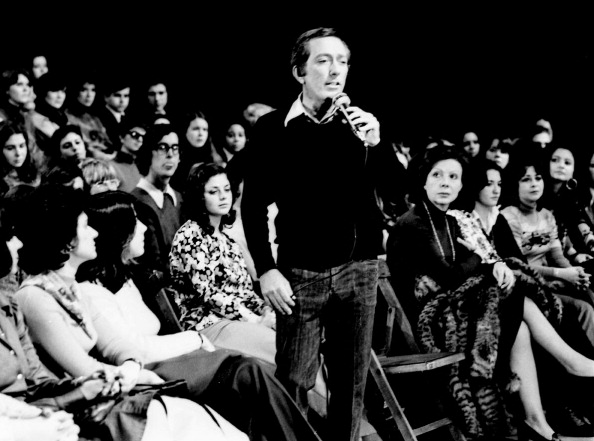
Andy Williams - may each day of the week be a good one...


'Depending on your age and race, Andy Williams' 1961 rendition of "Moon River" was either a transcendent embodiment of timeless beauty, or one of the more conservative, white-bread recordings of its time. Either your Christmas sparkled brighter because of his annual TV special, or it ruined an otherwise relaxing night. You loved or hated his taste in sweaters.'  (Los Angeles Times obit 26th Sept 2012)
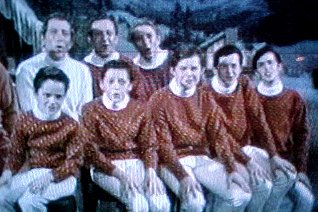
Andy Williams - educating the Osmond Brothers in The Way of the Sweater.

Whilst most nostalgia for the 1960s revels in images of hippiedom, Woodstock and Swinging London, there was also a more "conservative" aspect - the cosy sixties, if you like - which thrived and contributed to the bipolar culture of the decade.
Andy Williams with his first wife, Claudine Longet and their three children.
Andy Williams represented a sixties that, rather than kicking against the previous generation, saw itself as the natural progression from them... more stylish, more laid back. Along with Burt Bacharach, Andy Williams stood for the kind of sixties your parents would be glad to have you bring home.


Having started his singing career, aged 8, as one of the  Williams Brothers Quartet, (their first hit being "Swinging on a Star", recorded with Bing Crosby in 1944), Andy Williams's solo career gained him international fame and his own weekend variety show. 

The Andy Williams Show was so successful it was imitated by stars on both sides of the Atlantic (all of us of a certain age will either experience a glow in the stomach or a throbbing in the temples at the mention of The Val Doonican Show - one of the imitators).


The show featured a comforting standard format - songs, comedy (gently humorous sketches, featuring the host), and a weekly guest star).  This last slot gave opportunities to a surprising range of up and coming acts including The Carpenters, but most significantly, introduced many black American acts to a wider audience (included here, The Temptations, The Supremes, Gladys Knight and the Pips).
Andy with Sonny and a pre-op Cher - hands up if you preferred her that way.

Politically, Williams was friend and supporter of the Kennedys, and would later lead protests against plans by the Nixon administration to deport John Lennon.


This sense of personal integrity and loyalty was also evidenced when, in 1976, his by then ex-wife, Claudine Longet was charged with shooting dead her boyfriend. Andy Williams not only testified as to her character, but also financed her legal backing and escorted her to court appearances.


Andy Williams may have represented a less edgy and far from iconoclastic aspect of the sixties, but the legacy of the man and of his music provides much to be admired.


Saturday, 22 September 2012

Janis Joplin

Ah but you got away, didn't you babe,
you just turned your back on the crowd,
you got away, I never once heard you say,
I need you, I don't need you,
I need you, I don't need you 
(Leonard Cohen, "The Chelsea Hotel")

The Queen of Rock and Roll


Just like Jimi Hendrix, Janis seems to have "endorsed" an 'official' website from beyond the grave.  To be fair, it is referenced 'the Janis Joplin estate'. It's also a fine source of Janis info, so we'll leave it at that...

Janis Joplin, the woman with the voice that could simultaneously charm the birds out of the trees and strip the paint from walls.

Janis Joplin, the woman who inspired song and verse, and, let's face it, not a little hard drinking and illicit drug-taking.

Janis assaults a song with her eyes, her hips; and her hair. She defies key. shrieking over one line, sputtering over the next, and clutching the knees of a final stanza, begging it not to leave. When it does leave anyway, she stands like an assertive young tree, smiling breathlessly at the audience, which has just exploded. Janis Joplin can sing the chic off any listener.
Richard Goldstein, Vogue, May 1968.


                     One of the most watched videos on YouTube with over 14 million hits.

The Queen of Psychedelic Soul
Although her career lasted only about four years, and many of her key live performances were hampered by heroin and booze, Janis Joplin opened paths for women vocalists and her influence worked through Stevie Nicks, Pink, Alanis Morisette, Bonnie Raitt and many others. 

And who has ever had a better Porsche than this?
One admirer of her work who was not afraid to speak her mind, clearly felt the world did not deserve Janis:

"Yesterday I went to see Janis Joplin's film here, and I started to write a song about it, but I decided you weren't worthy. Because I figured most of you were here for the festival, and you just really... Anyway, the point is, it pained me to see just how hard she fell. Because she got hooked into a thing, and it wasn't on drugs. And she played to corpses." Nina Simone at Montreux Jazz Festival 1976.

The lamentable "trend" of dying young - something previously restricted to 19th century Victorian poets and their heroines - re-emerged in the sixties, with Jimi Hendrix as its king, Janis Joplin its queen.

Perhaps Nina Simone is right. Maybe we mere mortals don't deserve her and the rest of those supernovae of the sixties. Maybe we are just hopeless, soulless "corpses". But if we keep on listening, perhaps her voice may yet blow a breath of life into us... It's worth a try, don't you think?